

The Dwelling of the Name: The City that Bears His Name (Part 5 of 12)
Updated: May 1
The city chosen for His dwelling, engraved with His Name through history and prophecy.
© 2025 William F. Spivey Jr. All Rights Reserved (www.bible-is-history.com)
Introduction
The U.S. Census Bureau currently recognizes nearly 19,500 cities, towns, and villages across the United States—each with a name and a story.
Some honor people, others describe the land, and still others recall faraway places:
New York, NY – named for the Duke of York
Athens, GA – after the ancient Greek city
Long Beach, CA – for its long, sandy shoreline
Antioch, KY – after the biblical city in Syria
Place names preserve human history, but one city’s name was chosen by God Himself.
In Scripture, God also chose a city—not for its geography or power, but for His presence. That city is Jerusalem, mentioned more than 800 times in the Bible. It is where heaven’s story touches earth—where God placed His Name, His Temple, and His promise.
LET’S EXPLORE: From Genesis to Revelation, the Bible tells one continuous story—God’s desire to be in relationship with His creation, to dwell among His people. From Abraham to the apostles, every generation shows how the LORD marks people and places as His own. Yet this city is unlike any other.
In the last blog, we explored the people who bore God’s Name—Israel, the nation He chose and blessed to represent His character before the world.
This next post in The Dwelling of the Name series turns from the people to the place—the city chosen to bear His Name, Jerusalem: past, present, and future, the city where His glory once dwelt and will one day dwell again.
1 · Salem Before Jerusalem — The First Priest-King
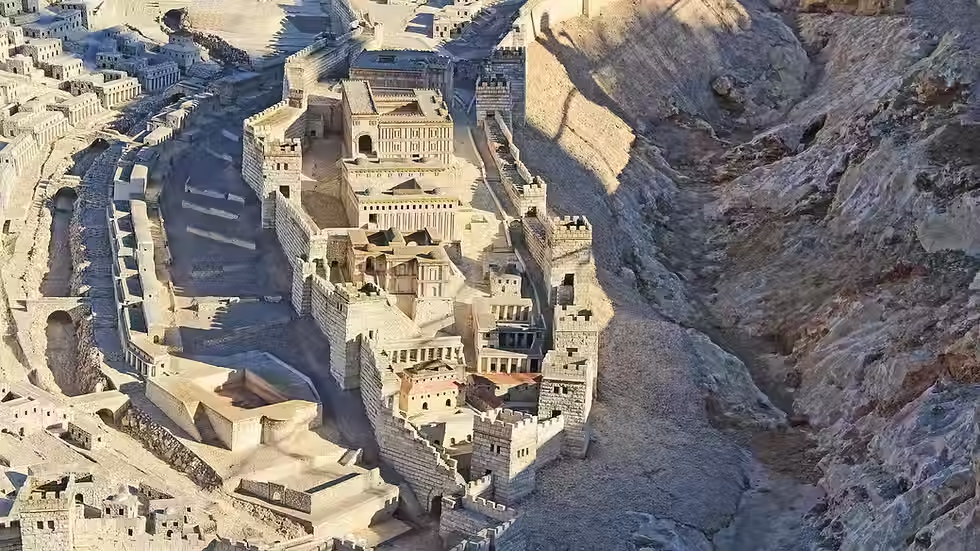
The city we now call Jerusalem first appears in Scripture as Salem, a name that means peace. It stood in the rugged hill country of Judea, far from the main trade routes.
Melchizedek was the name of its ruler—a name that means King of Righteousness. He was a faithful remnant of Noah—a believer in the God Most High, Maker of heaven and earth.
Salem was already marked by worship of the Most High. For a time, its people honored the Creator, not creation, keeping alive the truth of the one true God while idolatry spread around them.
After rescuing his nephew Lot from a coalition of kings (Genesis 14:1–16), Abram returned from battle by the high road through the hill country, avoiding the kings of the plains he had refused to ally with (Genesis 14:22–23).
There, by divine providence—not chance—he arrived in Salem, where he was greeted and blessed by Melchizedek in a prophetic manner:
“Then Melchizedek king of Salem brought out bread and wine. He was priest of God Most High, and he blessed Abram.” — (Genesis 14:18–19)
On that high road, righteousness met righteousness. Abram—soon to be called Abraham—was blessed by God’s priest, pointing to a greater covenant to come. Melchizedek’s background and actions were filled with meaning:
Bread and wine prefigure the body and blood of Christ at the Last Supper (Matthew 26:26–28, Mark 14:22-24, Luke 22:19-20);
King of Peace points to Jesus, the Prince of Peace (Isaiah 9:6–7);
Priest of the Most High God points to the eternal priesthood “in the order of Melchizedek” (Psalm 110:4)—one that represents God to all nations, unlike the Aaronic priests who served only within Israel (Exodus 28:1-4);
He was ‘without father or mother,’ outside the Levitical line (Hebrews 7:3, 15-17)—a priesthood appointed by God, not ancestry;
When he blessed Abram, “the greater blessed the lesser” (Hebrews 7:7), revealing a higher order of God’s righteousness;
Even his name—Melchizedek, king of righteousness—points forward to the Messiah, the “righteous Branch” (Jeremiah 23:5–6).
God could have made His covenant through Melchizedek—the priest of Salem who already honored the Most High. Yet in His sovereignty, the LORD chose Abram—not the man already in the holy place, but the one willing to leave home and obey God’s call.
Melchizedek kept the faith before the covenant; Abraham carried the covenant that spread God’s Name to all nations. In that meeting, the faith preserved in Salem met the covenant that would define all future generations—a divine appointment that ensured Jerusalem would one day carry the covenant Name itself.
Centuries passed. Salem’s faithfulness faded into history, its memory preserved only in Scripture and in the meaning of its name—peace. The city once ruled by a priest-king who honored God would later become home to the unfaithful Jebusites.
2 · The City Chosen to Bear His Name
When the Israelites went to conquer the Promised Land in 1406 BC, the city was occupied by the Jebusites (Joshua 10:16-26). Their king, Adoni-Zedek, was captured and killed, yet the Jebusites continued to occupy the city for nearly four centuries.
David’s men captured the mountain stronghold of Zion from them and claimed it as the City of David in 1003 BC (2 Samuel 5:6-9). The psalmist confirmed the ancient and prophetic link between Salem and Zion (Psalm 2:6, Isaiah 24:23, Joel 3:17, Micah 4:7):
“His tent [tabernacle] is in Salem [Jerusalem], His dwelling place in Zion [Temple Mount].” — (Psalm 76:2)
As king, David would make Jerusalem the capital of Israel. Yet its true distinction came not from David’s throne, but from God’s choice:
“I have chosen Jerusalem, that My Name may be there.” — (2 Chronicles 6:6)
"For the Lord has chosen Zion; He has desired it for His dwelling, saying, 'This is My resting place for ever and ever; here I sit enthroned, for I have desired it'." — (Psalm 132:13-14)
Yet God’s claim went beyond walls or buildings—even the land bore His mark.

From above, Jerusalem’s three valleys—the Hinnom, the Tyropoeon, and the Kidron—form the shape of the Hebrew letter ש (Shin), the first letter of Shaddai, meaning the Almighty.
Ancient teachers saw this as a sign that God’s Name was engraved upon His city, fulfilling His promise.

This letter Shin (ש) also appears on every mezuzah, placed at the doorposts of Jewish homes—the same reminder of God’s covenant Name dwelling among His people. The Name YHWH is written on the parchment scroll (klaf) inside a mezuzah. The city itself became like a living mezuzah—God’s Name written on the gates of the earth.
3 · The Glory Departed and Promised to Return
Though Jerusalem was chosen, the prophet Ezekiel saw the glory of the LORD depart from the city (Ezekiel 10:18–19). Yet even in judgment, God’s promises did not fail. The prophets spoke of a day when the glory would return:
“The LORD says: I will return to Zion and dwell in Jerusalem. Then Jerusalem will be called the City of Truth." — (Zechariah 8:3)
And Ezekiel foresaw the final fulfillment:
“And the name of the city from that day shall be, ‘The LORD is there.’ — (Ezekiel 48:35)
4 · Tears for the City — When the King Wept Over Jerusalem
Centuries after the prophets foretold the return of God’s glory to Zion, the Glory Himself entered the city—not in fire or cloud, but riding on a donkey. The crowds shouted “Hosanna!” yet within days their cries would turn to “Crucify Him.”
As Jesus approached Jerusalem on what we call the Triumphal Entry, He stopped to look upon the city that bore His Father’s Name. What He saw moved Him to tears:
“As He approached Jerusalem and saw the city, He wept over it and said, ‘If you, even you, had only known on this day what would bring you peace—but now it is hidden from your eyes. The days will come upon you when your enemies will build an embankment against you and encircle you… They will not leave one stone on another, because you did not recognize the time of God’s coming to you.’ " — (Luke 19:41–44)
Here, the Prince of Peace wept over the City of Peace. The very One whose Name was engraved upon its hills stood at its gate and lamented its blindness. The promise of shalom had arrived—but Jerusalem rejected her King.
In that same city, Melchizedek’s symbols found fulfillment. In the Upper Room, the true Priest-King offered bread and wine as His own body and blood—the new covenant of peace between God and humanity (Matthew 26:26-29).
No other city has been so loved, so warned, and so wept for by God Himself.
5 · The New Jerusalem — The City of Peace Restored
The story that began in Salem and reached its sorrow in Jerusalem ends in glory with the New Jerusalem—the eternal city where God and humanity will dwell together again.
The prophets longed for this day:
“See, I will create new heavens and a new earth… I will create Jerusalem to be a delight and its people a joy.” — (Isaiah 65:17–18)
John saw the fulfillment of those promises:
“I saw the Holy City, the New Jerusalem, coming down out of heaven from God, prepared as a bride beautifully dressed for her husband. And I heard a loud voice from the throne saying, ‘Now the dwelling of God is with men, and He will live with them.’ ” — (Revelation 21:2–3)
This is the third and final part of the city's story—the city that bears His Name forever. In the New Jerusalem, everything lost in Eden and wept for in old Jerusalem is restored. The curse is gone; the rivers of life flow again; and His servants “will see His face, and His Name will be on their foreheads.” (Revelation 22:4)
What began with Melchizedek’s bread and wine finds its eternal fulfillment at the marriage supper of the Lamb (Revelation 19:9)—the everlasting covenant of peace.
Here, heaven and earth finally meet without veil or temple. The city of peace becomes the home of the Presence. And the Name that once dwelt above the hills of Jerusalem now shines upon every redeemed face.
“The kingdoms of this world have become the kingdom of our Lord and of His Christ, and He shall reign forever and ever.” — (Revelation 11:15)
6 · Living in Light of the Name
1) What you just learned
You have learned that Jerusalem was not chosen for its strength, beauty, or political importance, but because God chose to place His Name there. From Salem under Melchizedek, to David’s Zion, to Solomon’s Temple, the city became the focal point of God’s dwelling on earth. Jerusalem’s identity was shaped not by what humanity built there, but by the favor that God placed upon it.
You also learned that God’s choice of Jerusalem did not guarantee perpetual blessing. When the city rejected the God whose Name it bore, His glory departed—yet His promises did not fail. The prophets foresaw a day when the LORD would return to Zion, and Scripture reveals that this return would ultimately be fulfilled not in a rebuilt temple, but in the Messiah Himself and, finally, in the New Jerusalem.
2) Why this is important
This matters because God’s choice of Jerusalem—and of the land of Israel—was intentional, not incidental. God placed His Name in a small, exposed land set at the crossroads of the ancient world, where what happened could not remain hidden. Positioned between continents and empires, the land ensured that God’s dealings with His people would be visible to the nations. Israel was never meant to be isolated; the land itself made God’s covenant relationship public. Its lack of natural strength required dependence, so that blessing and loss alike would testify not to Israel’s power, but to the faithfulness of the God who dwelt among them.
Yet Jerusalem was chosen for more than visibility—it was chosen for rule. Scripture presents the city not only as a dwelling place, but as the future seat of God’s reign over the nations. From Zion, the LORD would one day rule as King, establishing justice, peace, and righteousness for all the earth. In this way, Jerusalem was prepared as a throne before it was ever fully occupied. It stands as both a physical city and a prophetic pattern: just as God chose a place to set His Name and rule from there, so He seeks hearts prepared for His reign. Jerusalem teaches us that God does not seize authority by force; He establishes His rule where He is honored, awaited, and welcomed—first in history, and now in the hearts of those who will receive His Kingdom when it comes in fullness.
3) How this applies to sanctification
Sanctification is not merely about personal improvement or moral restraint; it is preparation for God’s rule. Just as Jerusalem was chosen, shaped, and tested long before it would become the seat of God’s reign over the nations, God’s people are being formed now as those who will live under—and reflect—His Kingdom. God prepares His dwelling before He establishes His throne.
4) Reflection and orientation
Scripture promises a day when “the LORD will be king over all the earth,” when there will be one LORD and His Name alone will stand (Zechariah 14:9). God’s future reign does not depend on human response—it is established by His authority. Jerusalem was chosen and prepared as the place from which that reign will one day be revealed, showing us how God orders His rule with intention, purpose, and patience.
Jesus taught that “out of the abundance of the heart the mouth speaks” (Matthew 12:33-37, Luke 6:45) revealing that what governs the heart inevitably governs the life. The heart functions like a throne room—not determining whether God is King, but revealing whether His kingship is reflected within us. Just as God prepared a city to bear His future throne, He calls His people to reflect His rule over every part of their lives. So the question is not whether God will reign, but whether our words, actions, and priorities testify that His authority is already enthroned at the center of who we are. Is there evidence that the King who will rule the nations is the One shaping our thoughts, directing our speech, and ordering our lives today?
Please visit the website at www.bible-is-history.com
Part 5 of 12 in The Dwelling of the Name Series
← Previous Series [The People Who Bears His Name]
Next in Series → [A Defense of His Name]
To receive new blog notices (wait for pop-up)


Comments